
Virtual queueing for events
The line still exists. Nobody has to stand in it.
Your attendees claim a time to arrive, then go and do something else. We tell them when to head over, and your staff wave them in with a scan — on the phones already in their pockets. Nothing to rent, nothing to install, nobody holding a clipboard at the gate.
Festival gates, badge pickup, timed entry — a few hundred people, or tens of thousands.
Four moves, start to door
You set the times. We hold the line, and tell people when it is their turn.
-
1
Set your arrival times
Say how many people you can take, and when. Lay out a whole day of arrival windows at once, and change any of them later.
-
2
People claim a place
Attendees pick a window, or join the waitlist and watch their position count down — including anyone who turns up on the day without one. One place each, however they got it.
-
3
We tell them when to come
The moment you are ready for the next group, they hear about it — by text, email, Discord or Telegram. You decide how much notice they get.
-
4
Your staff wave them in
Everyone arrives with a QR code that works exactly once. Your team scans it on the phones already in their pockets.
What your day looks like instead
A window, not a wall
People are given a time to arrive and the freedom to use it. Showing up an hour early earns nobody a better place, so there is nothing to be gained by queueing before you open.
Their clock starts when the phone buzzes
Each person picks the channel they actually read. Their time to reach the door starts when a message gets through — not when we first tried — so nobody argues that they never heard from you.
A pass that cannot leak early
There is no code in existence until it is somebody's turn, so there is nothing to screenshot in advance and nothing to pass around. It then works exactly once.
One place per account
Nobody holds a booking and a waitlist spot at the same time, and nobody jumps the line by signing up twice — not even when thousands are trying at the same moment.
Reach them where they are
Text, email, Discord, Telegram, or straight into a system of your own. If one channel fails the next is tried, and we keep track of who still needs telling.
You stay in control
Slow the line, open it up, or let somebody in by hand. Taking somebody out asks for a note, records who did it, returns their place to the line and kills their code — so you have the receipt when the email arrives three weeks later.
Built for scale
Built for the minute everybody arrives at once
The hard part of a queue is never the quiet afternoon. It is the ten minutes after the gates open, when everybody tries at the same time. That is the moment QueueKat is designed around.
Tens of thousands, one event
A single event can carry tens of thousands of attendees in one line. Your busiest minute is the one we size for.
Every door, every phone
Put as many scanners on as many entrances as you like, with no kit to rent and nothing to install. They all work from the same line, so more doors makes the queue move faster rather than messier.
The count is always right
A window with two hundred places hands out two hundred places, however many people hit it in the same second. And when somebody hands a place back — which costs them nothing, so they actually do it rather than quietly not turning up — exactly one place returns to the line.
A rush stays where it is
A stampede for the most popular time does not slow down anyone booking a quieter one. One busy moment never becomes a slow afternoon for everybody else.
When the day goes sideways
Plans slip, people are late, and the door never moves at quite the rate you expected. Here is what happens then.
Late is not the end
If somebody misses their window, their place goes to the next person — but they are not locked out. Your staff can still let them in, and the record shows how late they were.
The real door sets the pace
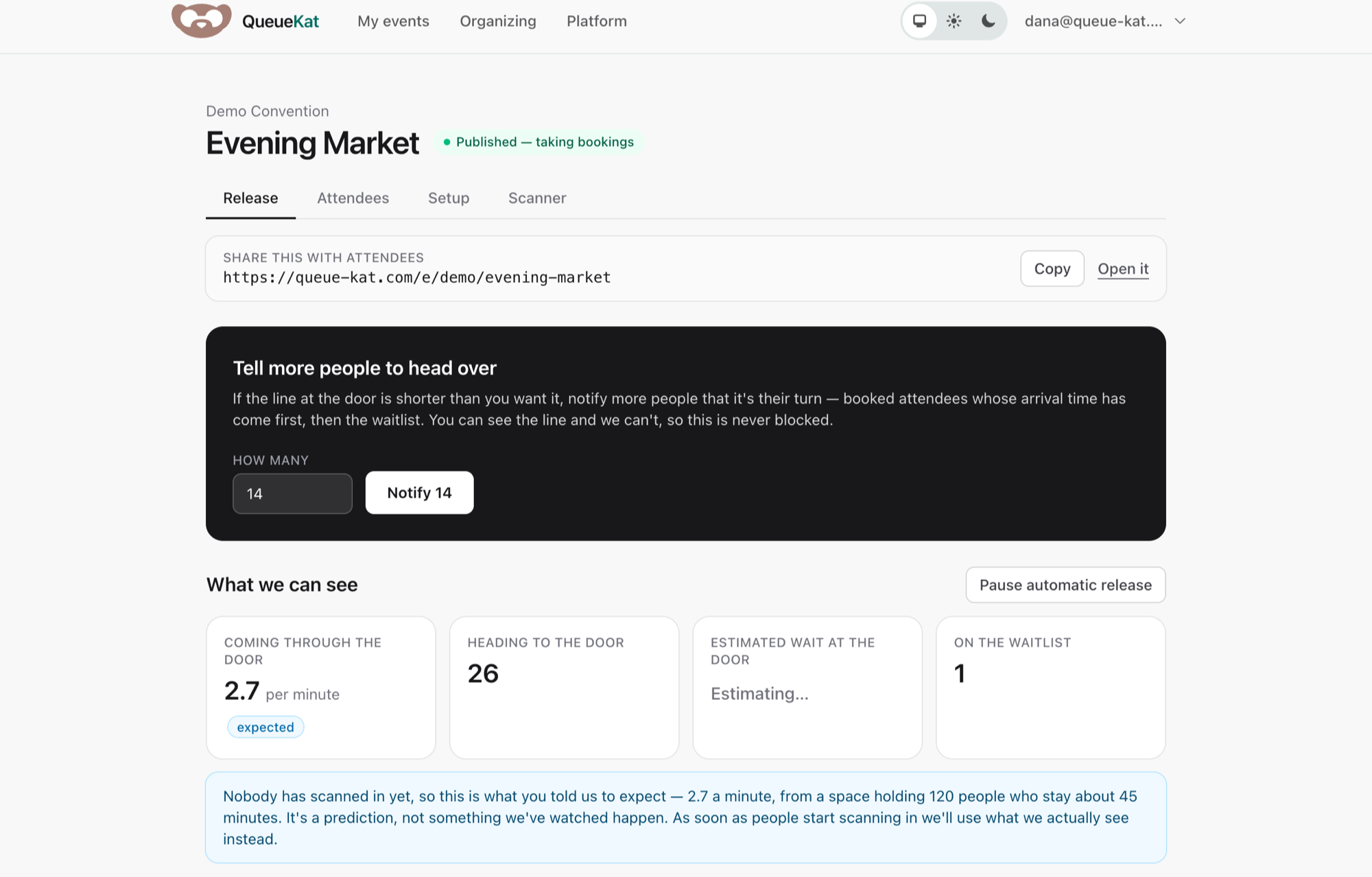
You tell us how fast you expect to move people. The moment real scans start coming in, what is actually happening at the door takes over from your estimate — you do not have to re-plan at ten in the morning.
We count, we do not guess
We tell you how many people came through your door, counted from actual scans. We will not tell you how many are inside the room, because that is not something we can know.
Put your next line online
Create an event, lay out a day of arrival times, and see the whole thing working before you commit to anything.
Want to see it first?
Write to us and we will show you a real event end to end — the console you run the day from, the pass on an attendee's phone, and the scanner at the door. Bring the awkward questions about your own gates and your own numbers.
Already have an account? Write to [email protected].